Facebook could be a hit with shoppers
By David Gelles in San Francisco
Published: August 5 2009 03:00 Last updated: August 5 2009 03:00
A new wave of sophisticated e-commerce applications is appearing on Facebook, a sign that the world's largest social network could rapidly emerge as a big destination for online shopping.
1-800-Flowers, the US floral gift retailer and distributor, last week opened its "Facebook storefront", an application running on Facebook's fast-growing platform where users can purchase and send flowers.
At least 20 more such storefronts will appear on Facebook in the next two months, according to Wade Gerten, chief executive of Alvenda, the software developer that built the 1-800-Flowers storefront. "You'll see a lot more coming out in the next couple of months," he said.
Mr Gerten said he had contracts to develop eight storefronts, but that since the 1-800-Flowers application launched, he had secured 12 more. He said the applications would be for "very large general merchandise retailers, and very large electronics retailers".
The storefronts represent the beginning of a transformation that could turn Facebook into a retail destination, said Sucharita Mulpuru, an e-commerce analyst for Forrester Research. "It's an enormous platform," she said. "That means the ability to reach more consumers and make money."
Facebook has more than 250m users and is growing fast. However, it has no current plans to organise the storefronts into an online mall, or to make money from them by either taxing the transactions that take place on its site, or by offering its own virtual currency.
At least two other companies already have limited e-commerce functionality in their Facebook applications. Sears, the department store, and Threadless, the T-shirt seller, both let users add items to their shopping cart on Facebook. But to complete the transaction users must go to the company's own website. Allowing users to remain on Facebook while they complete their transactions is important in increasing the site's "stickiness". More than 120m people log on to Facebook each day, spending a combined 5bn minutes a day on the site.
Companies are turning to social media sites such as Twitter and Facebook to help them boost business. Many big retailers have a fan page on Facebook, while retailers large and small are offering exclusive deals to their Twitter followers.
But neither site has been able to make money from the increased business activity. Instead, Facebook is focusing on attracting advertisers, and is expected to bring in at least $500m in revenue this year.
Copyright The Financial Times Limited 2009
Showing posts with label Financial Times. Show all posts
Showing posts with label Financial Times. Show all posts
Wednesday, August 05, 2009


Tuesday, September 25, 2007
FT: The 3-Piece Suit Returns
 FT WEEKEND - FASHION
Getting waisted It's elegant, versatile and practical. Simon Brooke celebrates the return of the three-piece suit.
By SIMON BROOKE
22 September 2007
Financial Times
"Put me in a three-piece suit and I tend to resemble Roger Moore in his appalling early 1980s period, but without the raised eyebrow," says London-based men's wear designer Simon Carter. So why is he making such a feature of suits with waistcoats in his collection for this autumn?
Simple: his clientele are asking for them. "There's suddenly a revival of interest in the three- piece suit," says Carter. "It's actually a very versatile look, because you can add all kinds of detail to the waistcoat, such as extra pockets. Last year it was our biggest seller at Selfridges."
Indeed, the recent return of the suit and a more dressed-up approach to men's wear has brought with it the waistcoat. While some designers consider the reappearance of what Americans call the "vest" to be evidence that the much-vaunted return of the dandy is now fact and not supposition, others see the phenomenon as a more macho kind of development.
"I missed the three-piece suit the first time around because I'm too young, but I love them," says solicitor James Tilbury, 31. "They're masculine and actually very neat - they keep your shirt and tie in order when you've taken off your jacket. Since I've started wearing my three-piece suit in meetings, I've heard nothing but praise . . . There must be lots of men who would love to wear a three-piece suit and are just waiting to be told it's back."
"I think one reason people don't wear three-piece suits any more is because they think they're restrictive but, actually, they're still really elegant and are very popular with our customers as they are quintessentially British," says Sir Paul Smith, who created a City pin-striped suit with a two-button notch lapel suit jacket this season and another in traditional gamekeeper check in chocolate and camel. Ede & Ravenscroft also has pin-striped three-piece suits in its collection. Matthew Farnes, its bespoke tailor, is finding that younger customers who have not worn them before are beginning to ask for them.
Mark Donnor, 33, who runs a real estate private equity fund, has a collection of three-piece suits, including a morning suit, which he had made at Ede & Ravenscroft for his wedding. "It's a very neat, sharp look," he says. But it's also very practical - you can use it for pens and notes when you've taken your jacket off in the office."
"One customer told me that he feels really dressed up, really ready to work - the pin-stripe is always popular and has real impact," says Farnes. "Waistcoats also allow men to show their individual style. I've made one with a purple backing, for instance, which looks very striking, a bit like wearing red braces. It's also very functional because you've got those useful extra pockets."
A two- or three-button singled-breasted jacket works best with a waistcoat, advises Farnes. Men can also wear their trousers higher, with the waistband under the waistcoat, for a more elegant, elongated silhouette, while today's lighter fabrics mean that even with the extra layer of clothing, wearers will not feel too hot and encumbered.
"The three-piece suit felt right for the autumn/winter collection, even though for some time it's been considered a little old-fashioned," says Carlos de Freitas, head of men's wear at Dunhill. "For our collection, we've created a new slimmer silhouette with a shorter jacket that has a contemporary edge. As men's wear has become progressively more casual, it is good to have something in the wardrobe that is refined and sophisticated."
He's not the only one who thinks so. "Over the past few seasons, we've seen a general return in men's wear to more sophisticated and elegant dressing," says Robert Triefus, Giorgio Armani's executive vice-president. "The waistcoat continues that direction, especially when it's worn with tone-on-tone shirts and more fitted jackets. It combines for a very contemporary feel."
Outside the office, waistcoats also work well. Tony Lutwyche, of London tailor Lutwyche Bespoke, finds that although some clients once associated three-piece suits with John Travolta's brilliant white number in Saturday Night Fever, they increasingly appreciate how a waistcoat can make clothes more elegant for the evening and, indeed, other occasions. "With more men getting married in dinner jackets," he notes, "quite often you find that the groom wants a really elegant waistcoat just to help differentiate him from the other men there."
"Put me in a three-piece suit and I tend to resemble Roger Moore in his appalling early 1980s period, but without the raised eyebrow," says London-based men's wear designer Simon Carter. So why is he making such a feature of suits with waistcoats in his collection for this autumn?
Simple: his clientele are asking for them. "There's suddenly a revival of interest in the three- piece suit," says Carter. "It's actually a very versatile look, because you can add all kinds of detail to the waistcoat, such as extra pockets. Last year it was our biggest seller at Selfridges."
Indeed, the recent return of the suit and a more dressed-up approach to men's wear has brought with it the waistcoat. While some designers consider the reappearance of what Americans call the "vest" to be evidence that the much-vaunted return of the dandy is now fact and not supposition, others see the phenomenon as a more macho kind of development.
"I missed the three-piece suit the first time around because I'm too young, but I love them," says solicitor James Tilbury, 31. "They're masculine and actually very neat - they keep your shirt and tie in order when you've taken off your jacket. Since I've started wearing my three-piece suit in meetings, I've heard nothing but praise . . . There must be lots of men who would love to wear a three-piece suit and are just waiting to be told it's back."
"I think one reason people don't wear three-piece suits any more is because they think they're restrictive but, actually, they're still really elegant and are very popular with our customers as they are quintessentially British," says Sir Paul Smith, who created a City pin-striped suit with a two-button notch lapel suit jacket this season and another in traditional gamekeeper check in chocolate and camel. Ede & Ravenscroft also has pin-striped three-piece suits in its collection. Matthew Farnes, its bespoke tailor, is finding that younger customers who have not worn them before are beginning to ask for them.
Mark Donnor, 33, who runs a real estate private equity fund, has a collection of three-piece suits, including a morning suit, which he had made at Ede & Ravenscroft for his wedding. "It's a very neat, sharp look," he says. But it's also very practical - you can use it for pens and notes when you've taken your jacket off in the office."
"One customer told me that he feels really dressed up, really ready to work - the pin-stripe is always popular and has real impact," says Farnes. "Waistcoats also allow men to show their individual style. I've made one with a purple backing, for instance, which looks very striking, a bit like wearing red braces. It's also very functional because you've got those useful extra pockets."
A two- or three-button singled-breasted jacket works best with a waistcoat, advises Farnes. Men can also wear their trousers higher, with the waistband under the waistcoat, for a more elegant, elongated silhouette, while today's lighter fabrics mean that even with the extra layer of clothing, wearers will not feel too hot and encumbered.
"The three-piece suit felt right for the autumn/winter collection, even though for some time it's been considered a little old-fashioned," says Carlos de Freitas, head of men's wear at Dunhill. "For our collection, we've created a new slimmer silhouette with a shorter jacket that has a contemporary edge. As men's wear has become progressively more casual, it is good to have something in the wardrobe that is refined and sophisticated."
He's not the only one who thinks so. "Over the past few seasons, we've seen a general return in men's wear to more sophisticated and elegant dressing," says Robert Triefus, Giorgio Armani's executive vice-president. "The waistcoat continues that direction, especially when it's worn with tone-on-tone shirts and more fitted jackets. It combines for a very contemporary feel."
Outside the office, waistcoats also work well. Tony Lutwyche, of London tailor Lutwyche Bespoke, finds that although some clients once associated three-piece suits with John Travolta's brilliant white number in Saturday Night Fever, they increasingly appreciate how a waistcoat can make clothes more elegant for the evening and, indeed, other occasions. "With more men getting married in dinner jackets," he notes, "quite often you find that the groom wants a really elegant waistcoat just to help differentiate him from the other men there."
Wednesday, August 01, 2007
Pinkberry makes the Financial Times
 I think this means that Pinkberry is big-doin's...business-wise. Watch for the IPO.
By Jonathan Birchall
Published: August 1 2007 03:00 Last updated: August 1 2007 03:00
Just after 11 o'clock at night at the Pinkberry frozen yoghurt store on Manhattan's Eighth Avenue, a young woman was pleading unsuccessfully to be let in as staff members prepared to shut for the night. "It's for my friend," she begged. "He's never had one."
Earlier that evening, the line of customers had stretched outside the store, with a cross section of the young and hip who populate the Chelsea neighbourhood waiting to order one of the two available flavours of tart yoghurt - plain or green tea - with a range of toppings both healthy and indulgent.
Frozen yoghurt is not new to the US where it emerged as a supposedly more healthy alternative to ice-cream in the 1980s. But with 40 outlets around Los Angeles and three so far in New York, the rapid growth of Pinkberry is leading a yoghurt revival that is rooted in an unusual blend of cross-cultural exchange and entrepreneurship.
In southern California, Pinkberry's ability to attract crowds since it was founded there in 2005 has spawned a host of imitators, such as Snowberry, IceBerry,Berri Good and Kiwiberri. In Manhattan, Zabar's, the gourmet supermarket, has launched a "Za-berry" yoghurt bar.
The Pinkberry chain was launched by Shelly Hwang, a Korean who came to the US to study business at the University of Southern California, and her partner Young Lee, a Korean-American who moved to the US with hisfamily as a child.
Ms Hwang's first venture was aimed at opening a small restaurant serving a "high tea" concept in West Hollywood and it failed. She says she was given the idea of frozen yoghurt - using a newer, more tart recipe and fresh fruit toppings - by Mr Lee, a former student of the Parsons school of design in New York.
Mr Lee had the idea of making store design central to the brand's identity. To achieve a higher, premium price, the "old idea repackaged in a new way", as he calls it, had to undergo a Starbucks-like transformation. The sales counter of traditional plain frozen yoghurt outlets was out. The approach emulates the attention to design detail that took the Seattle coffee-store chain worldwide.
"I wanted people to have a department store experience rather than a grocery store experience," he says. "It's a chore to go the grocery but a luxury to go to a department store."
The stores have an acrylic glass and stainless steel retro look, with a heavy Phillippe Starck influence. The mood, which deliberately refers back to the frozen yoghurt heyday of the 1980s, is reinforced by the use as background music of remixed hits by bands of the period such as Spandau Ballet.
To create Pinkberry's stylish brand identity they also brought in Yolanda Santosa, a Hollywood designer responsible for credit sequences for the feature film 300 and the Desperate Housewives television series. And in a tribute to the 1980s, they commissioned a song, "Sorry Ice Cream, I'm going to Pinkberry", from Lady Tigra, who as a member of pop group L'Trimm had a hit with "Cars that Go Boom" in 1988.
"I hate to use the word hip," Mr Lee says. "But for $5 you getsomething which is very unique . . . you get 15 minutes of feeling cool and hip."
Pinkberry's founders insist that the idea grew out of Mr Lee's own experiences - that he had the idea after visiting Vienna in 1985 and tasting gelato-style frozen yoghurt, followed by a trip to Hawaii where he sampled fresh pineapple and soft-serve ice-cream.
But Pinkberry's growth in the US also follows the expansion of frozen yoghurt outlets during the past five years in South Korea.
There, the growth in popularity of frozen yoghurt does not have traditional roots. Instead it has been fuelled by a national interest in wellness and "functional" food choices that mirrors consumer sentiments in the US. Heinz, after all, stresses the presence in its tomato ketchup of lycopene (a red pigment said to help prevent cancer) and Twinings boasts of the antioxidant powers of its teas.
Red Mango, one of Korea's largest frozen yoghurt chains, this summer opened its first store in Los Angeles, pointedly calling itself "the original healthy frozen yoghurt". The company, founded by a Korean entrepreneur, Roni Kim, opened its first store in Korea in 2003, and has expanded to 130 locations. It has also spawned a host of imitators, including Yoguteria and Babyyogurt.
Mr Lee and Ms Hwang say the fact that they are part of the -Korean-American community has not been a significant factor in the chain's expansion, except perhaps indirectly. Their area developerfor the New York area is Dai Hwan Choi, a college friend of Mr Lee.
"The Korean community has helped us in a very ironic way," says Mr Lee. "They copied us and used the word 'berry' a lot - Iceberry, Snowberry and so on."
Pinkberry so far has been entirely self-funded. Mr Lee will not give overall sales figures but the business has an operating margin of 4.8 per cent and a gross profit margin of 20 per cent, he says. Each store serves at least 1,600 customers a day.
Pinkberry's path to success has not been without its hurdles. Recently it fell foul of California's stringent laws when it was discovered that the product did not meet the state's definition of what constitutes yoghurt, as set down by the department of food and agriculture. In response Pinkberry removed all references to frozen yoghurt from its website.
So far most of the stores are operated by the owners, who are wary of franchising before they have established the chain's reputation. But after being deluged by about 3,000 franchising applications, Mr Lee and Ms Hwang have selected eight for future national expansion. New stores are planned in Las Vegas, Florida and Arizona. A first UK outlet is planned for London's Canary Wharf. They are not interested in selling the chain.
Mr Lee insists that this willnot prove to be a short-lived craze. "To me it's not a fad, because our first store opened two-and-a-half years ago and people are still going back for more."
And while the frozen yoghurt craze of the 1980s faded, its main protagonists survived. TCBY frozen yoghurt, founded in 1981 and owned by Mrs Fields Famous Brands, has more than 1,000locations across the US. ICBY, founded in 1978, has more than 1,000 outlets and is owned by Canada's Yogen Fruz.
And Tasti D-Lite, a New York chain of 60 stores launched in 1987, was sold by its founders to a private equity firm in February. Its new chief executive says he "intends to make Tasti D-Lite the number-one 'good-for-you' frozen dessert in the world".
Those walking Manhattan's streets in search of a late-night fix of frozen yoghurt may soon have more options.
Pinkberry's green tea flavour is not the only Asian-influenced fast food dessert concept tickling US taste buds.
Having originated in Japan, the Beard Papa chain is making waves with its European-style cream puffs (right), which began life in a bakery in Osaka. Beard Papa already has more than 200 stores in Asia, 20 in Hawaii and California, and six on the US east coast, with locations in prime shopping malls. The company's global expansion plans include the UK and Brazil.
However, past examples suggest that crazes of this kind do not always stay in vogue. In the late 1990s, Los Angelenos started drinking sweet "bubble tea" with tapioca balls, a drink that had originated earlier in the decade in Taiwan. Demand for the drink led to the creation of three small US chains - Lollicup, Q-Cups and Tapioca Express - all founded by west coast-based Chinese-American entrepreneurs.
Today bubble tea can be found in Chinatowns in many parts of the world, including London, Paris and Sydney, but the taste for "boba" tapioca balls has not spread far beyond Asian communities.
Copyright The Financial Times Limited 2007
Sunday, October 29, 2006
Financial Times: how to spend it
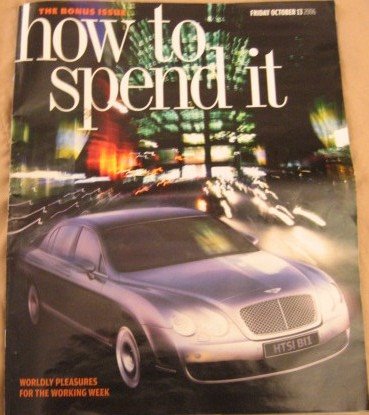
Do you read the Financial Times? It's the pink newspaper that is not The New York Observer. It's also the daily newspaper with the highest demographic in the world, i.e. its readers are global moguls with average incomes of like $47 billion. And they read it to figure out how to make even more next year.
I read it most everyday for my day job -- it's actually a great paper. But the best part is its weekly weekend magazine, "how to spend it." Aside from recommending exotic vacation spots and where to find the best cigars and cognacs, it features some of the most astounding couture, with styling and photography that rivals the top fashion books (or so I've heard, I hardly ever read women's magazines, believe it or not).
Like spending a day in Barneys and Bergdorf's, I merely read this insert to find out what is happening in the world of high-end fashion. I will not likely ever be able to...I mean want to - I have my principles, of course!...spend so much money on clothing. However, it is one of the sources from which I form my ideas about what looks and which designers are driving fashion. It arms me with a mind's eye of what I should be looking for as I cruise town as a (wo)man with a mission.
In the edition pictured above, an embroidered lace dress by Alexander McQueen tickles my fancy. And it only costs 4,190 GBP, which, when you take into account the strength of American currency, tranlates into something like $57,000.
Tuesday, October 17, 2006
Furniture part I: Pink Couchie
 There is something extremely important about making that leap from milk crates-and-Ikea to real live, grown-up furniture. First of all, the prices of grown-up furniture are like Crazy Eddie: INSANE. Secondly, like good shoes and haircuts, IT IS WORTH IT.
During the past several years I have painstakingly sought the perfect pieces of furniture to adorn my sprawling 1-bedroom apartment. To the point where it's arguable that nothing actually goes together, but I have convinced myself it's ecclectic and that each piece will serve as the perfect foundation for each room of that breathtaking penthouse I will certainly inherit from a long lost uncle.
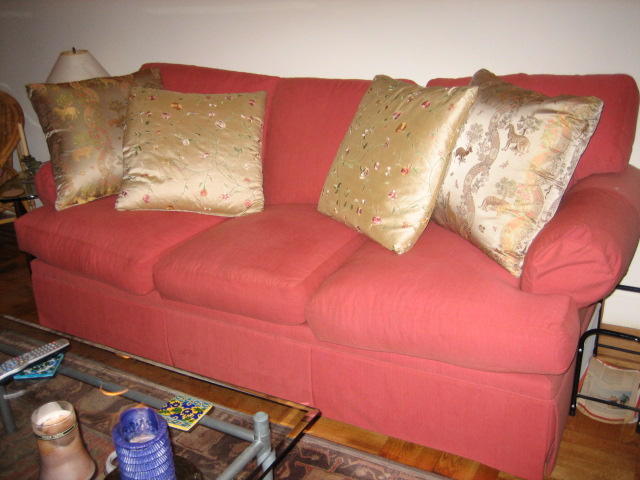
Anyway, back in the real world, a couple of years ago I began a serious mission to buy a new pink couch, as the couch I "borrowed" from my parents' house had lost all hope. She and I were the same age, and she didn't wear as well. Sadly, she had lost the spring in her step...
So what did I do? I listened to my parents and visited the Furnitureland South web site where I found Drexel Heritage brand furniture and decided it looked pretty good. At the time there was a Drexel Heritage store in NYC, so I visited it, checked out the couches, the fabrics and the accessories, wrote down all of the corresponding product ID numbers and ordered it through Furnitureland South instead...for half the price (no wonder the retail store went out of business!).
So I got my $1,500 pink (OK, "salmon") couch for less than $800! As a result of having saved so much moola, I also decided to order 4 oversized throw pillows in fabulous fancy fabric of my choice. To top it all off, the kind folk at Furnitureland South delivered the goods and set it up in my pad. This kind of service cannot be overlooked!
Stay tuned for the next furniture edition: beds...
Subscribe to:
Posts (Atom)


 Posts
Posts

